
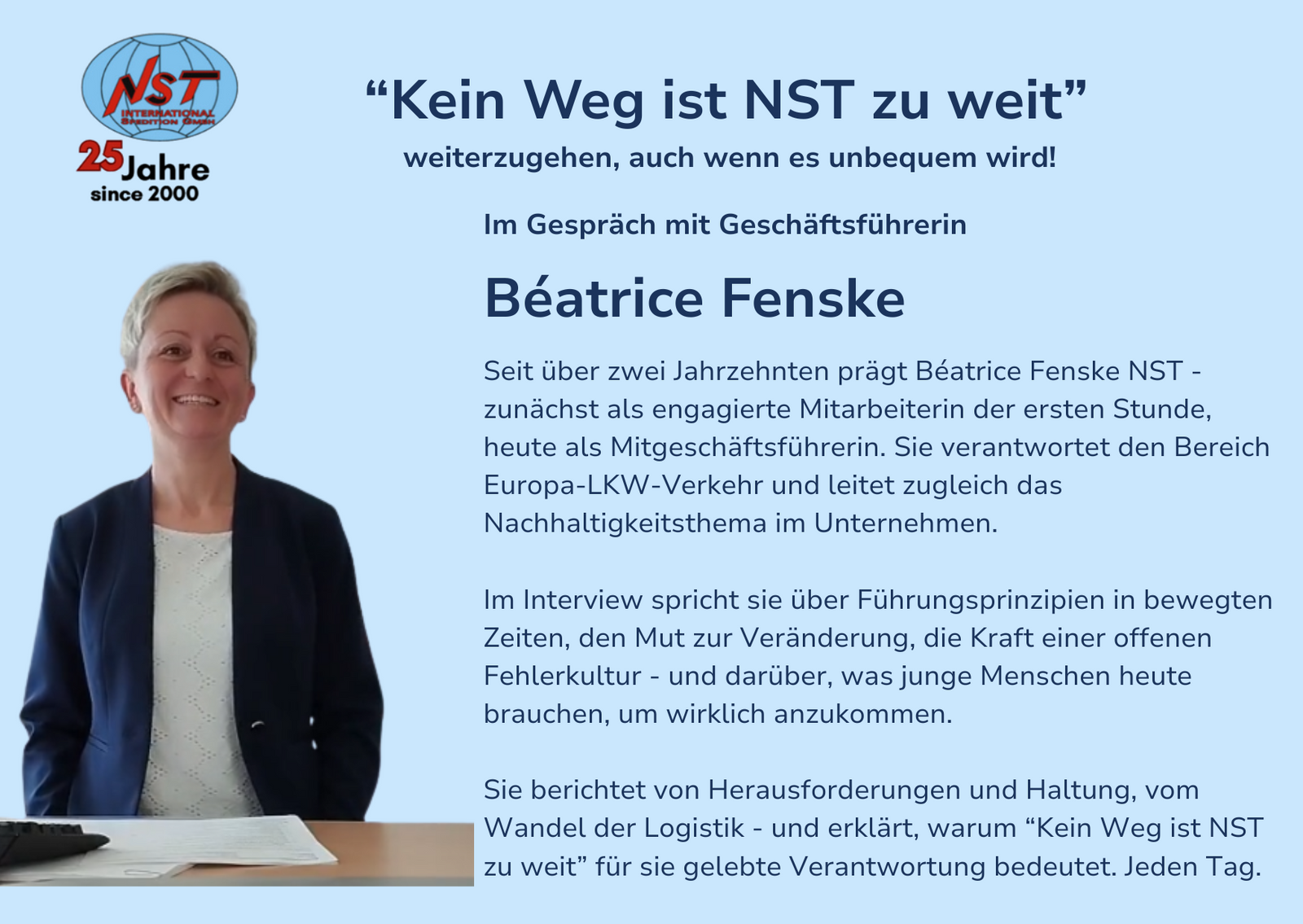
Béatrice Fenske in conversation: 25 years of "No Road Is Too Far" - keep going, even when it gets uncomfortable!
"Personal customer contact used to be a matter of course"
Ms. Fenske, you have been with NST almost since its inception. In your opinion, what has changed the most over all these years?
Looking back, it's primarily the service expectations that have changed significantly – and with them, the communication channels. In the past, personal exchanges and direct customer contact were central. Today, much of it is automated through booking portals. Of course, this brings efficiency, but it also makes things much more impersonal. It happens that customers react with surprise when you simply call them – even though that used to be completely normal.
Everyday work itself has also changed. The pace has become faster, the shipment throughput per employee much higher. This means more responsibility, more organization – and, above all, good teamwork to be able to handle this pace in the long term.
For me, leadership means: giving space, not controlling
How do you personally manage to practice leadership – not just organize it – in this fast-paced daily routine?
For me, leadership always begins with trust. I am convinced that people give their best when they are given the space to do so – and when their abilities are taken seriously. I see my role as creating this space for them, guiding them, advising them, and directing them when necessary – not in the sense of control, but in the sense of orientation.
A fundamental prerequisite for this is that our employees are well-informed and trained. Those who understand the overall context can act independently – and that is a great asset, especially in a dynamic environment like logistics.
Our error culture is also important to me. We openly discuss what didn't go well – without assigning blame, but with an eye to the future: What can we learn from it? This is not always comfortable, but it is very effective. Mistakes are part of the journey – and they help us to improve.
Young people need freedom and perspective
Promoting young talent is a topic particularly close to your heart. In your opinion, what does it take for young people not only to start but also to stay?
I believe that young people today are looking for more than just a secure job. They want to contribute, develop, and shape things. And that's a good thing – because the company also benefits from it. That's why we create a work environment that is varied, challenging, and offers prospects.
Further training opportunities are an important part of this – not just traditionally in the seminar room, but also flexibly via online tools, independent of time and place. Anyone who wants to learn is given the opportunity to do so with us.
And we encourage young people to think beyond their actual workplace: Anyone interested in sustainability can get involved there. Anyone with ideas for training is welcome to contribute them. We want them to feel that their voice matters. Even if processes have existed for 25 years – they can be questioned and improved. That's exactly what makes us a vibrant company.
Sustainability begins with attitude – not with a label
NST is an official Environmental Partner of the City of Hamburg – and you lead the topic of sustainability. What does this mean specifically for your work?
For me, sustainability is not a marketing topic – it's an attitude. That's why it was important for me to acquire the necessary technical knowledge. I trained as a climate protection manager and sustainability manager to be able to make informed decisions – for our company, for our employees, and for our customers.
Our approach is clear: avoid, reduce, compensate. For example, we created a greenhouse gas balance sheet – even though we are not legally obliged to do so. Why? Because we can only improve what we measure. This was complex, but very insightful.
In everyday life, we pay attention to many seemingly small things: We consciously purchase promotional materials, buy coffee in bulk instead of individually portioned, use glass bottles instead of plastic. And we actively participate in programs like Stadtradeln (City Cycling). These are not major revolutions – but they show commitment.
Employee motivation is also very important to me. We have set up an internal sustainability team that regularly discusses progress, ideas, but also what hasn't worked. Because in sustainability, too: only those who are honest remain credible.
"No road is too far" – a matter of attitude
NST's slogan is: "No road is too far for NST." What does this sentence mean to you personally?
For me, it's far more than just a slogan. It's an attitude that runs through everything we do. It means continuing – even when it gets uncomfortable. Not giving up when things get complicated. Finding ways when the direct path is blocked. Even taking longer, more strenuous routes – for our customers, for our colleagues, for our partners.
This sometimes makes our work challenging, but that's exactly what makes it so interesting and valuable. It's about reliability – about the promise to take responsibility. Even when it's not the easiest way.
Future with values – and room for shaping
What do you wish for the future – for NST and for your role in it?
I hope that we continue to live our values: commitment, openness, courage to change. That as a company we remain curious – and at the same time grounded. That we continue to grow – not only economically, but also as a team.
For my own role, I wish to continue to be able to shape things. To provide impetus. To promote people. And together with our team, to ensure that NST remains a place where responsibility is not just on paper – but is lived out every day. Every day.


